
UC Berkeley MEng
292C: Human-AI Design Methods Spring 2026
Best Overall Project
Team:
Nevin Bangloy
Haotong Wang
Semina Yi
Mingjie Zheng
and of course, me :)

Project Overview
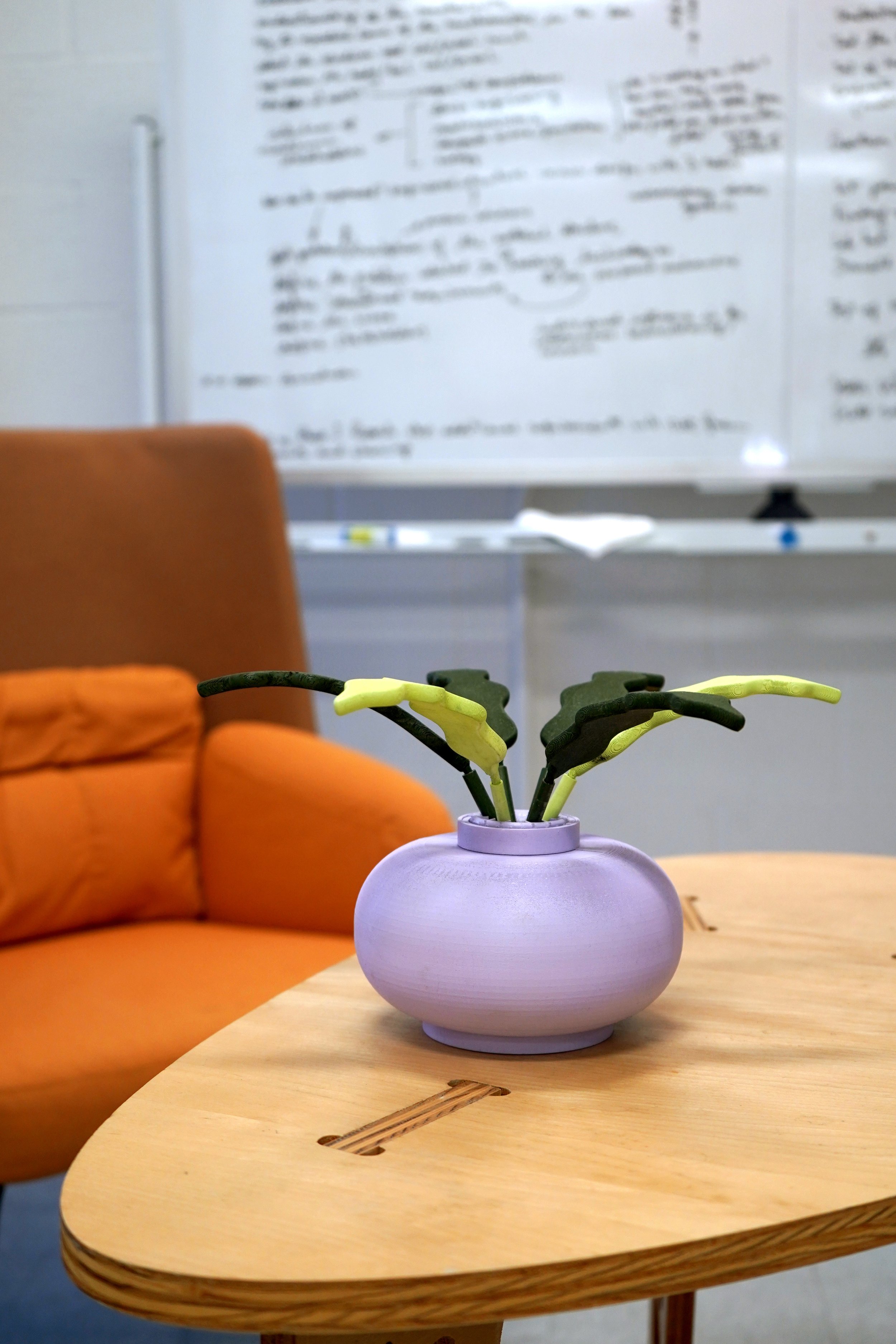
Buddi is a biomorphic smart-home device shaped like a small potted plant. It senses indoor environmental conditions — temperature, humidity, CO₂ — and communicates them through physical leaf movements. When the room is healthy, the leaves stand upright. When conditions decline, they droop. No screen, no app, no numbers. Just a plant that wilts when your air isn't good.
The idea is simple, but the design problem behind it isn't: how do you get someone to care about something they can't see, don't understand, and don't prioritize, without adding another notification to their life?
no screens, no numbers
·
less data, more meaning
·
proactive not reactive
·
ambient intelligence
·
no screens, no numbers · less data, more meaning · proactive not reactive · ambient intelligence ·
The Brief
For my Human-Centered Design course at UC Berkeley's Jacobs Institute, my team set out to explore indoor environmental health — specifically, the gap between what's happening in your air and what you actually do about it. Over the course of the semester, we conducted interviews, observational studies, and extensive synthesis work to arrive at a product concept, then built it into a functional prototype that we presented and tested at the Jacobs Design Showcase.
My contributions spanned the full arc of the project: I conducted a semi-structured interview and an in-context observational study during the research phase, contributed to synthesis and concept selection, and then led circuit design, sensor calibration, UI/UX, and mechanical prototyping through to the final deliverable. This page walks through my design process from beginning to end.
The Problem with Indoor Air
Indoor environmental health is invisible and abstract. Aspects such as temperature, humidity and CO₂ matter for comfort and long-term wellbeing, but they don't announce themselves the way a dirty kitchen or a pest infestation does. Current smart-home solutions try to solve this with dashboards and data, but our early research suggested that more information might not be the answer. (As someone who's spent hours staring at sensor readouts while debugging ESP32 projects, I can confirm: more data does not automatically mean more understanding.)
As a team, we framed a central question:
How might we translate invisible indoor environmental data in a way for residents to understand a declining room state before physical symptoms and signs emerge?
Before we could design anything, we needed to understand how people actually relate to their indoor environment. Not just in theory, but in practice.
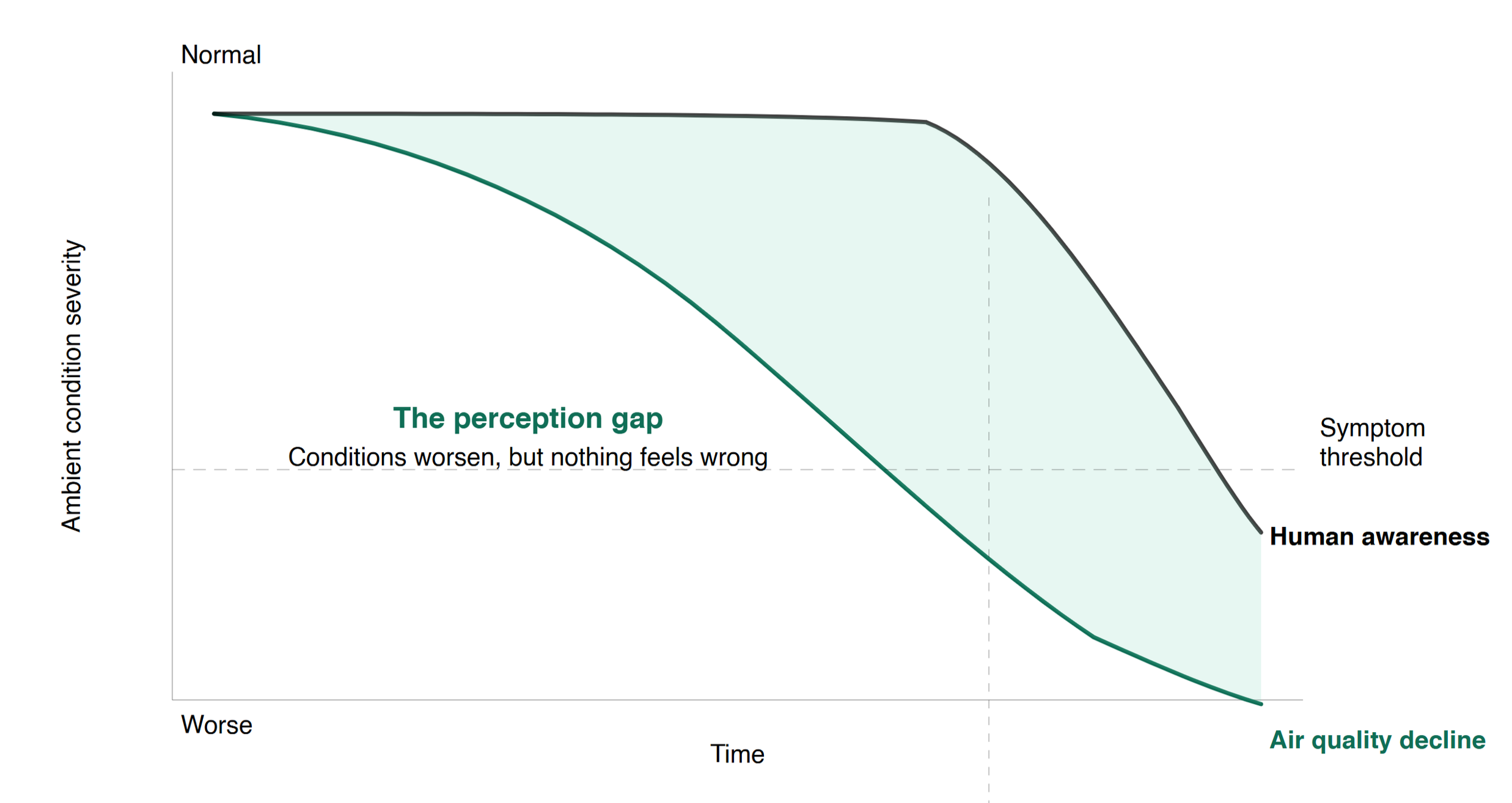
I contributed two primary pieces of research: a semi-structured interview with an individual living in a shared apartment, and an in-context observational study of someone cooking in a space with poor ventilation. Both ended up shaping the product direction in ways I didn't expect going in.Researching the Product Space
The Interview
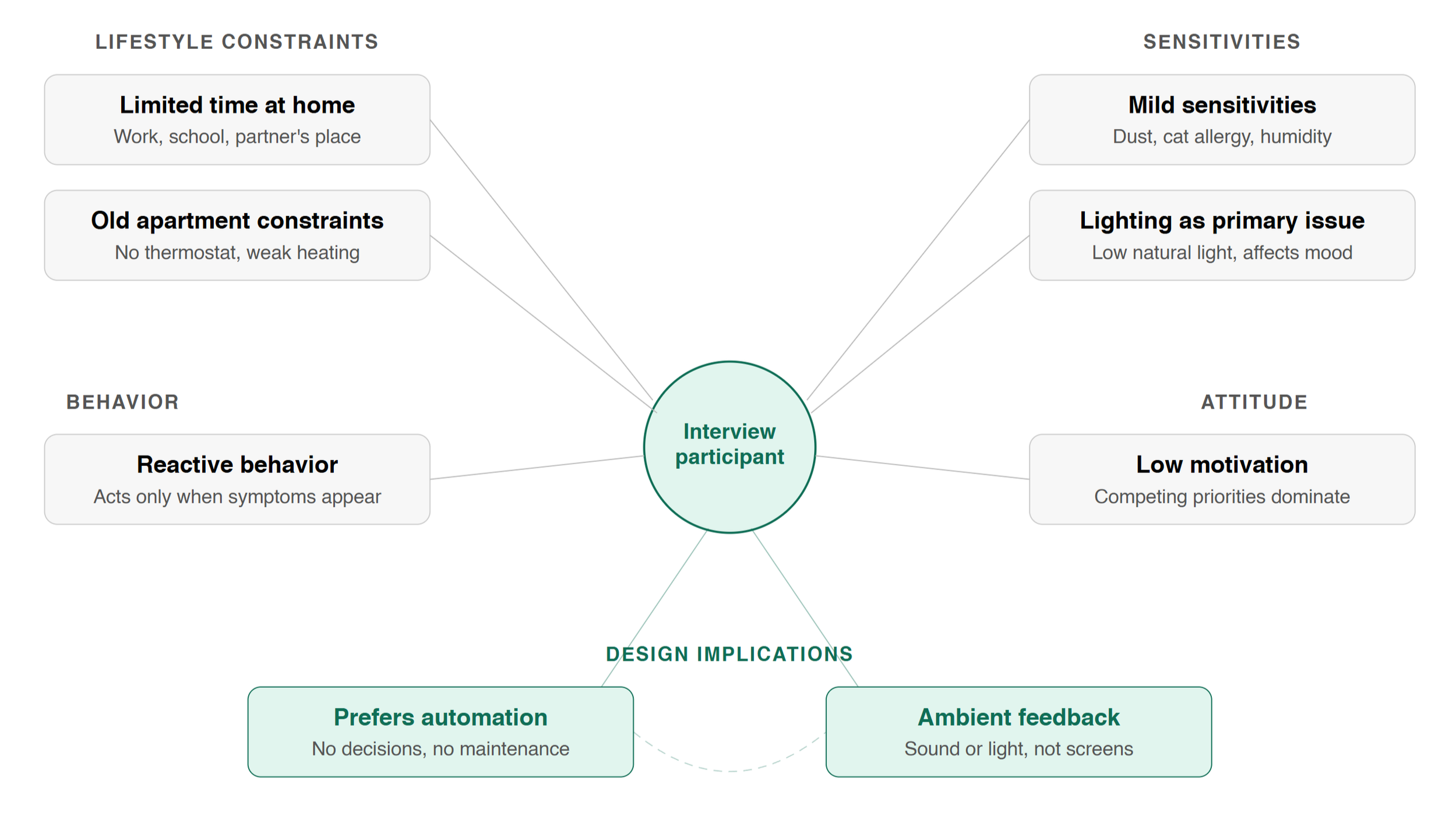
I interviewed a 22-year-old master's student living in an older San Francisco apartment with two roommates. She was a busy person; between work, school, and her partner's place, she was rarely home. I expected to hear complaints about air quality or temperature. Instead, what I got was something closer to indifference.
She had mild sensitivities — dust made her sneeze, her roommate's cat triggered eye irritation, her room got stuffy — but her response to all of it was the same: wait for it to pass, or do something minimal like opening a window. She'd previously owned an air purifier but gave up on it because it was bulky and the filter changes were annoying. When I asked what she'd change about her environment, she said the lighting. Not the air. Not the temperature.
Two things from this interview stuck with me. First, when I asked how she'd want a device to communicate environmental information, she didn't want a screen or numbers, since she would rather have sound or lighting cues, something she wouldn't have to actively monitor. Second, she wanted whatever it was to be automatic. She explicitly said she didn't want to make decisions about her environment. She wanted something that handled it so she didn't have to think.
I used AI tools to process the transcript afterward, extracting keywords, clustering themes, analyzing emotional tone. The synthesis confirmed what I'd felt sitting across from her: this wasn't someone suffering from a problem. This was someone who didn't have the bandwidth to care. That distinction turned out to be the most important insight of my entire research phase. You can design a solution for someone who's frustrated. Designing for someone who's indifferent requires a fundamentally different approach.
The Observational Study
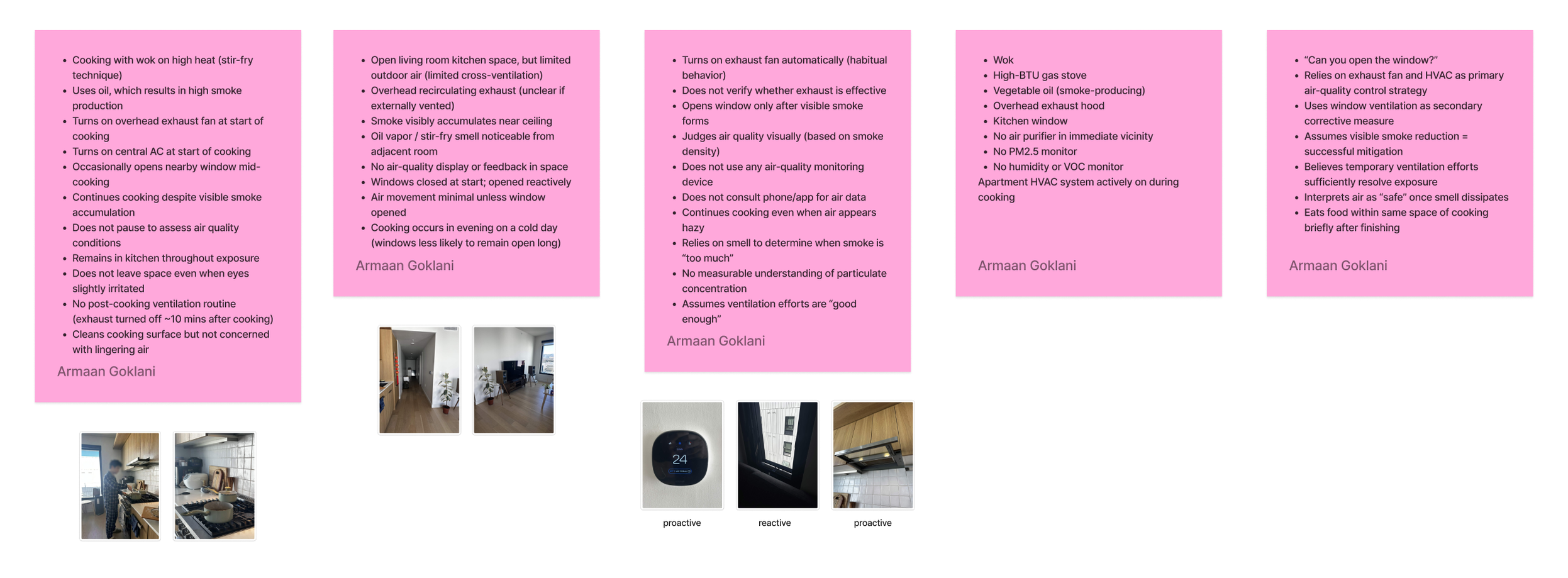
My second research contribution was an in-context observation. I watched a participant cook with a pot on high heat and stir-frying with oil, which produces significant visible smoke.
I documented everything: the environment, the sequence of actions, and the gaps between what the participant could have done and what they actually did. The kitchen was an open living room setup with limited cross-ventilation. The overhead exhaust was recirculating. Windows were closed at the start. Smoke accumulated near the ceiling. Oil vapor was noticeable from the adjacent room.
The participant turned on the exhaust fan at the start of cooking automatically, out of habit, not because they'd assessed the air. They opened a window partway through, but only after smoke was visually obvious. They continued cooking despite the haze, didn't leave the space even when their eyes were slightly irritated, and turned the exhaust off about 10 minutes after finishing. There was no post-cooking ventilation routine. They cleaned the cooking surface but didn't seem concerned about lingering air quality.
I coded the behavioral patterns I observed: exhaust fan use was habitual, not deliberate. The participant judged air quality by smoke density and smell, not by any measured standard. They assumed visible smoke reduction meant the air was fine. They relied on the exhaust fan and HVAC as their primary strategy and treated window ventilation as a backup. They interpreted the air as "safe" once the smell went away. They ate in the same space shortly after cooking.
This observation crystallized something the interview had hinted at: people don't manage air quality, they manage perceptible symptoms. Smoke they can see, smells they can notice, irritation they can feel. Everything below that threshold goes unaddressed. Any product that communicates through numbers or data is fighting against this reality. A product that makes the invisible perceptible, through a channel as intuitive as a plant wilting, instead works with it.
Connecting the Dots
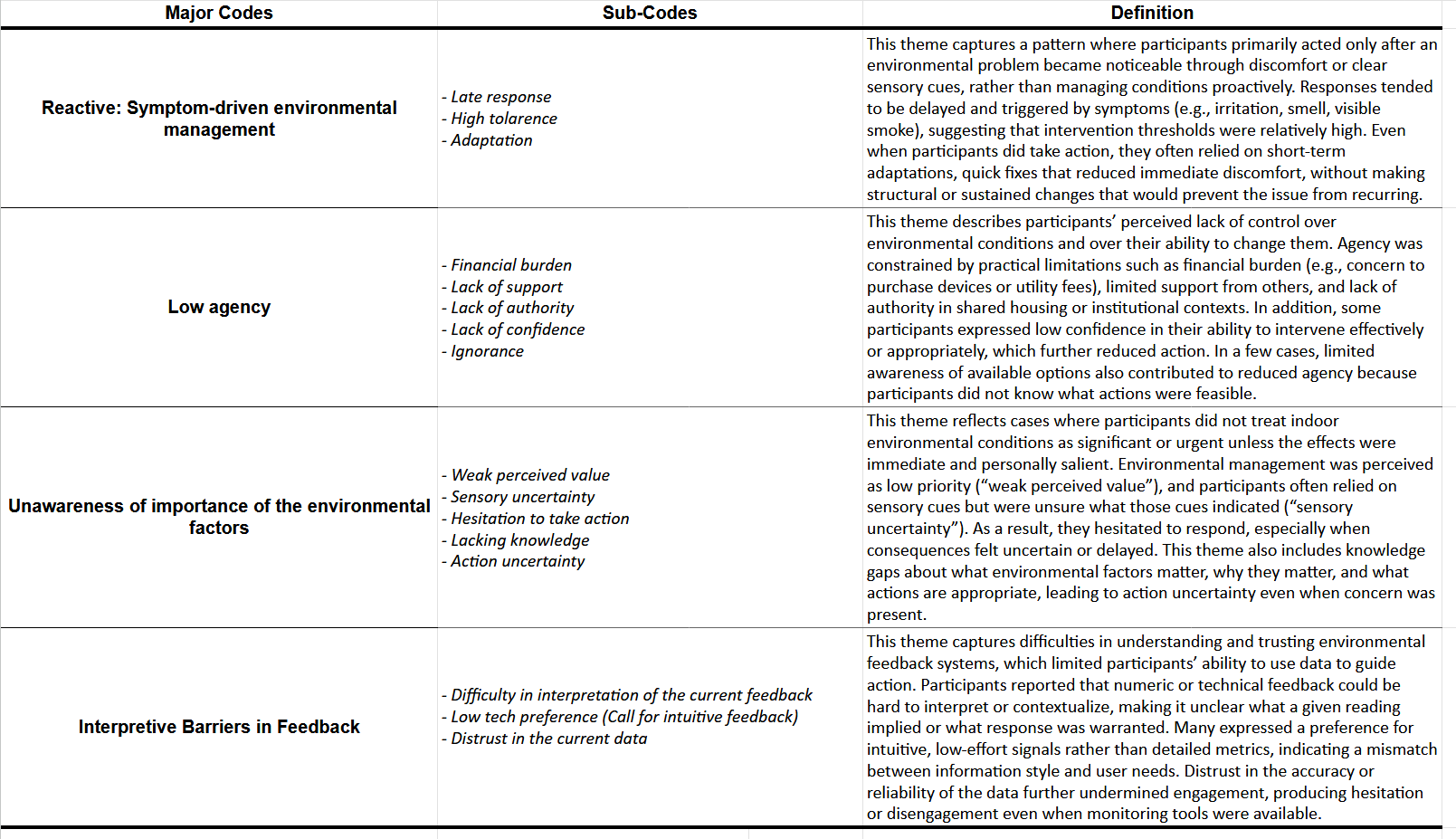
My findings fed into the team's broader synthesis alongside Semina's observational studies and everyone else's interviews. Together, we transcribed and coded the data through affinity mapping and inductive line-by-line open coding, clustering excerpts into themes directly from the language participants used.
Four key insights emerged across the full dataset. Environmental management was reactive and symptom-driven. People intervened only after discomfort, never proactively. Users reported low agency, feeling constrained by shared living situations, building limitations, or competing priorities. There was a widespread unawareness of environmental factors unless effects were immediate or disruptive. And participants struggled with interpretive barriers, such that numeric indicators didn't translate into confident action.
These weren't abstract findings for me. My interview participant was almost a textbook case of low motivation and reactive behavior. She managed her environment only when symptoms demanded it and explicitly deprioritized it against school and work. My cooking observation was a clear case of symptom-driven management combined with total unawareness of invisible factors like particulate concentration. And honestly, coding someone else's cooking habits while knowing I do the exact same thing was a humbling exercise in self-awareness.
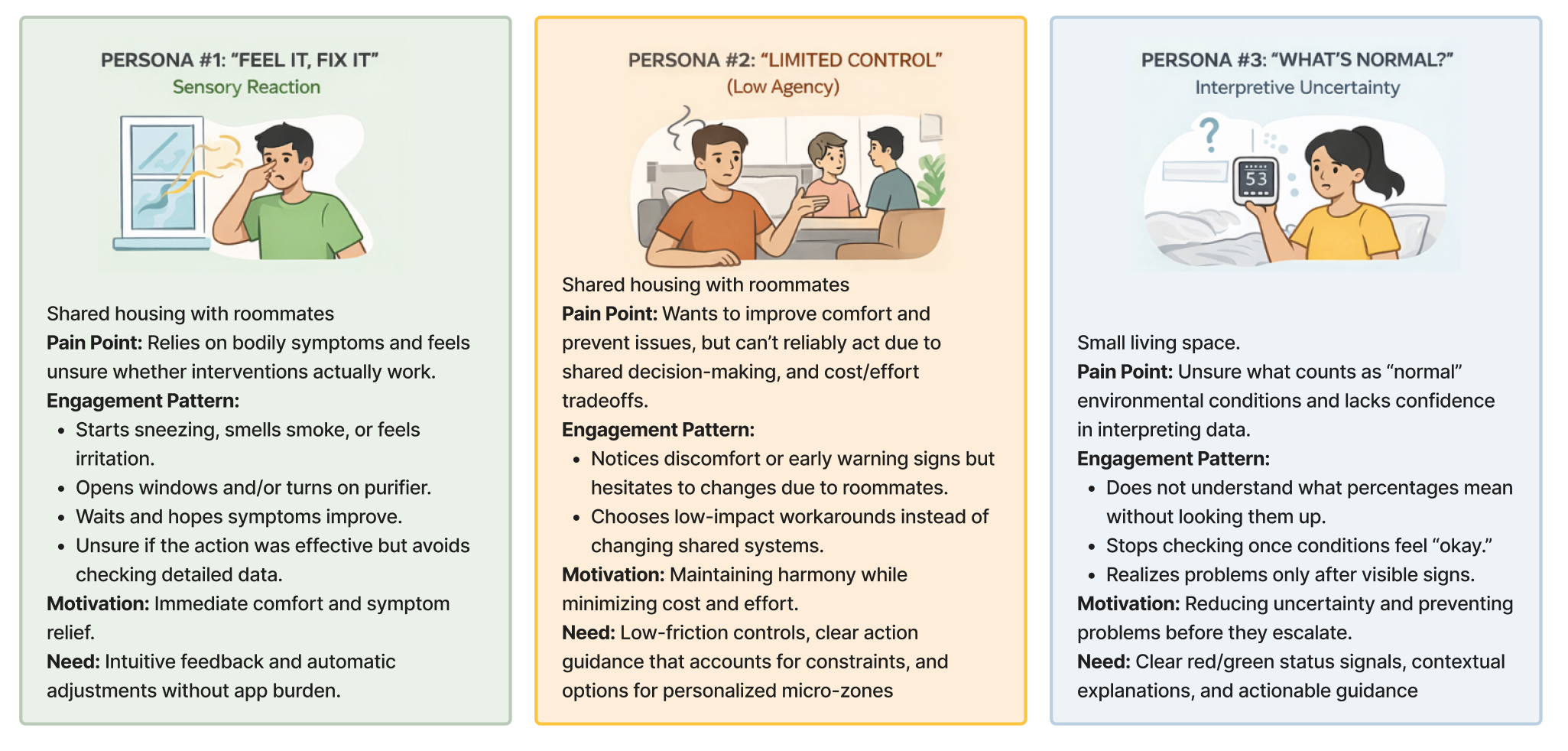
The team also constructed three AI-assisted personas grounded in this data. The one that resonated most with my research was Persona #2: Limited Control, someone who wants to improve comfort but can't reliably act due to shared decision-making, cost concerns, and competing priorities. They need low-friction controls and clear guidance that accounts for real-world constraints. My interview participant was practically the case study for this persona.
Concept Generation and Selection
Once we had our insights locked in, it was time to figure out what to actually build. The team used an AI-augmented process to go wide first and narrow later. We generated a big pool of concepts, and each of us went deep on our own before bringing everything back to the group.
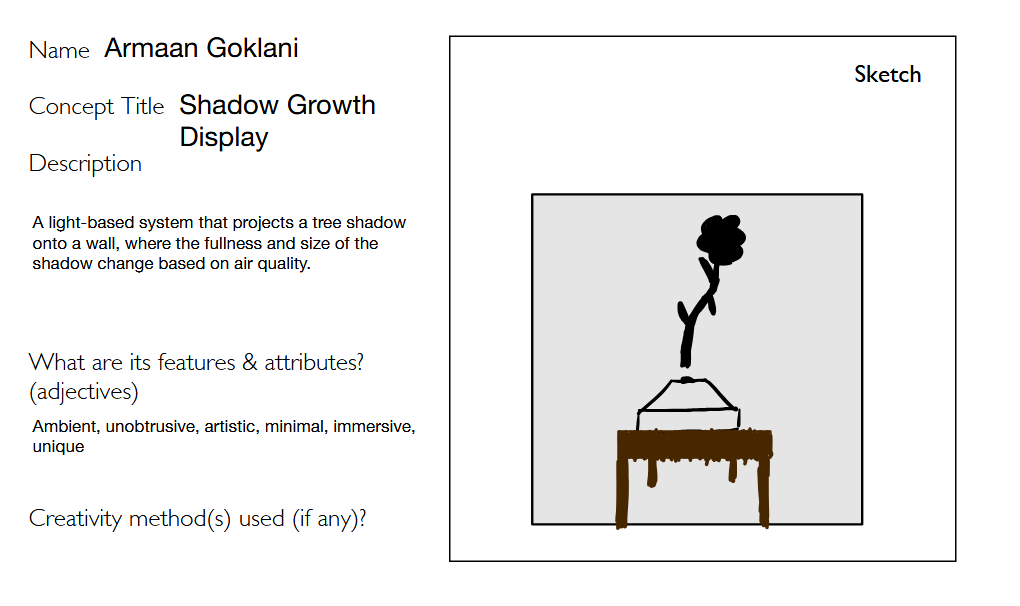
Below are some of the concepts I personally generated during this phase. You can see the range we were working with, from the practical to the ambitious to the "probably not buildable in a semester but fun to think about."
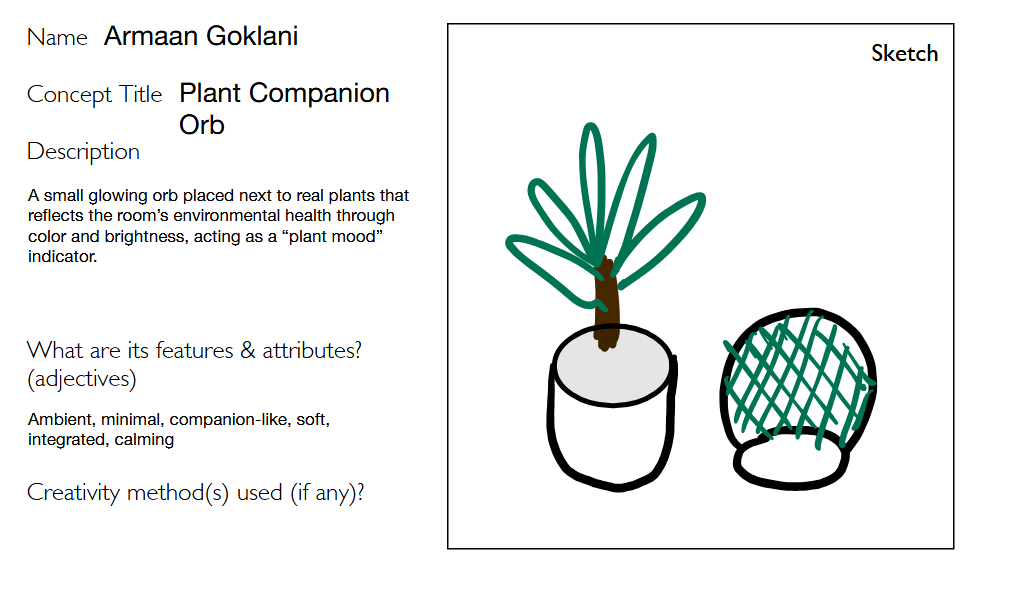
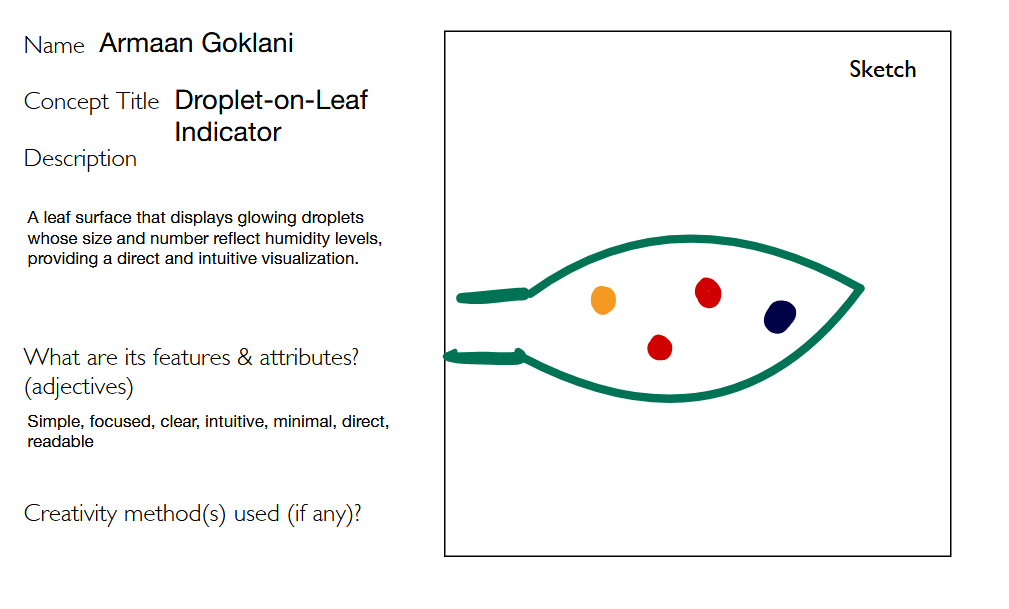
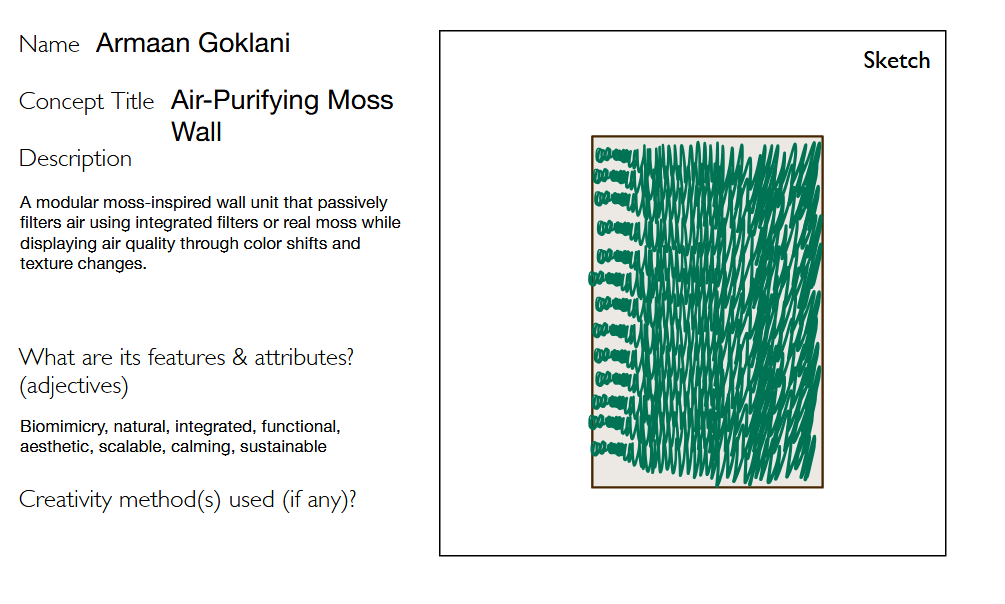
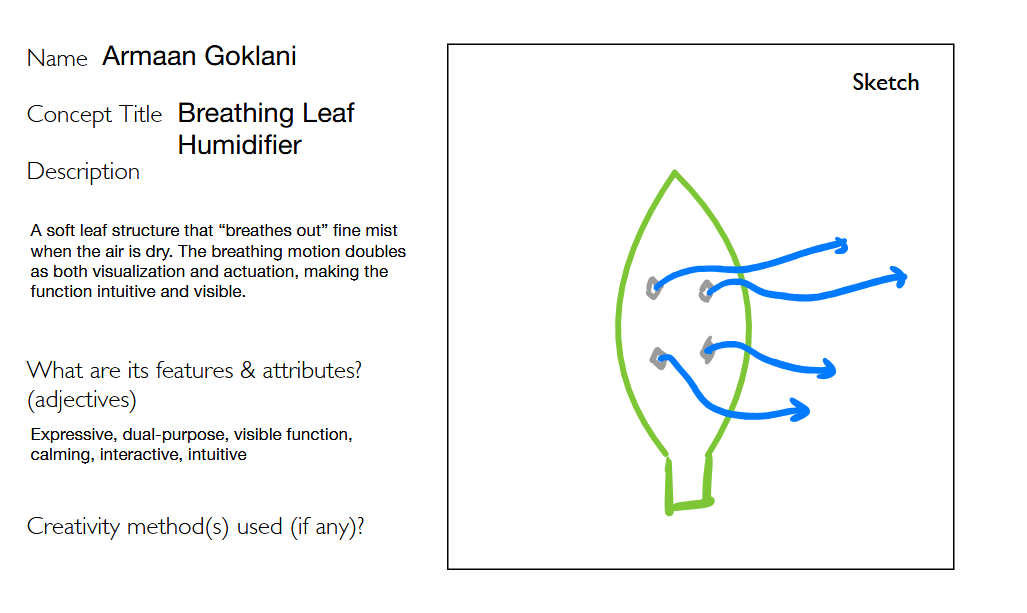
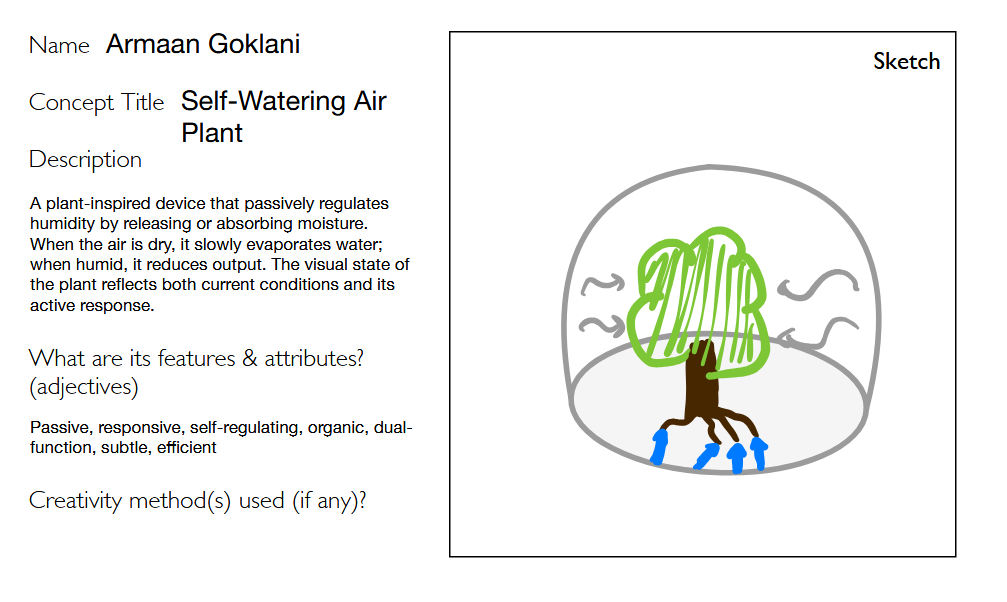
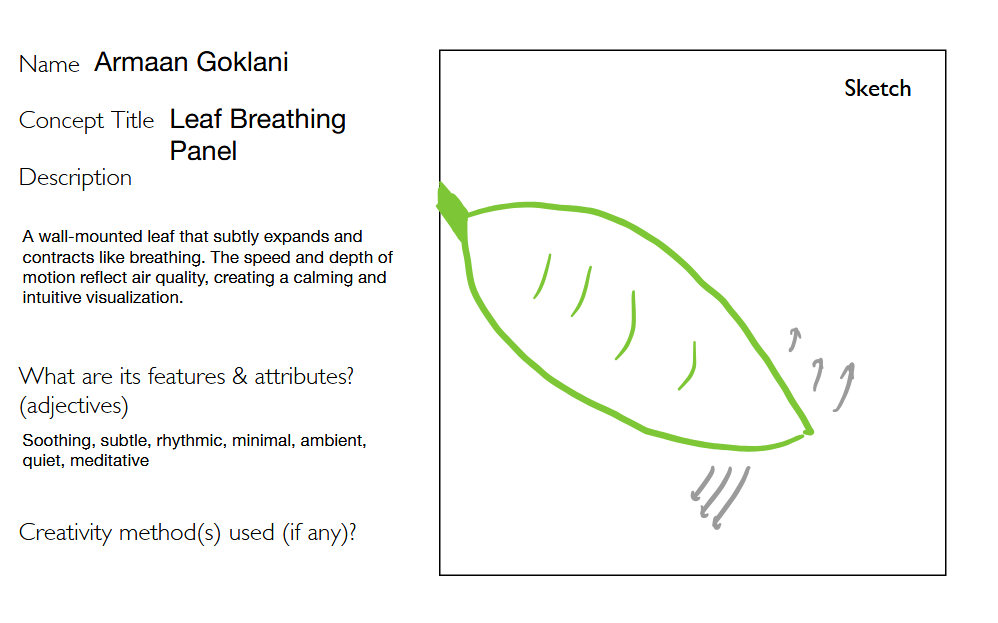
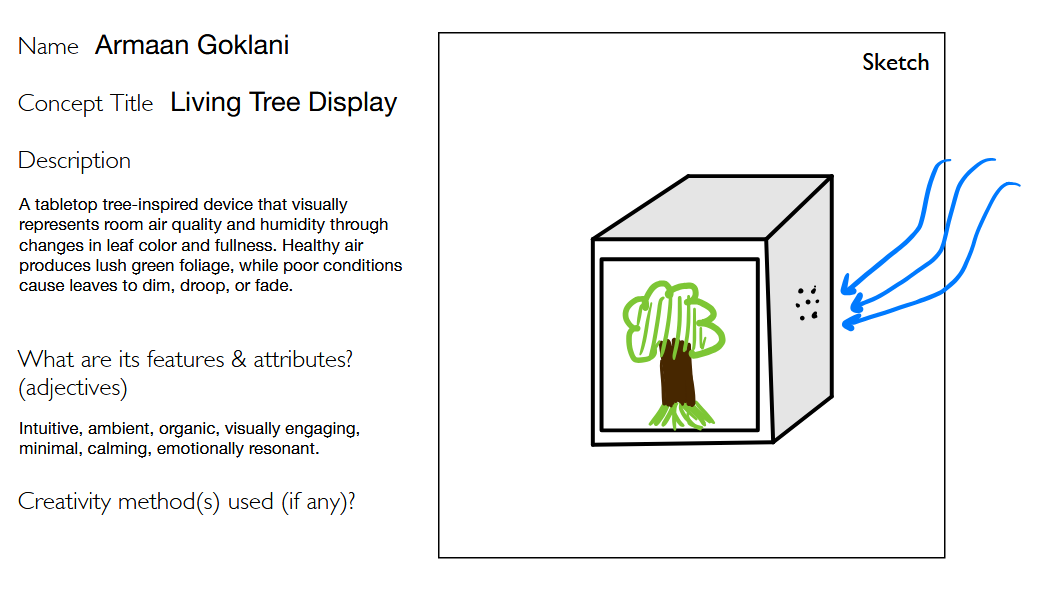
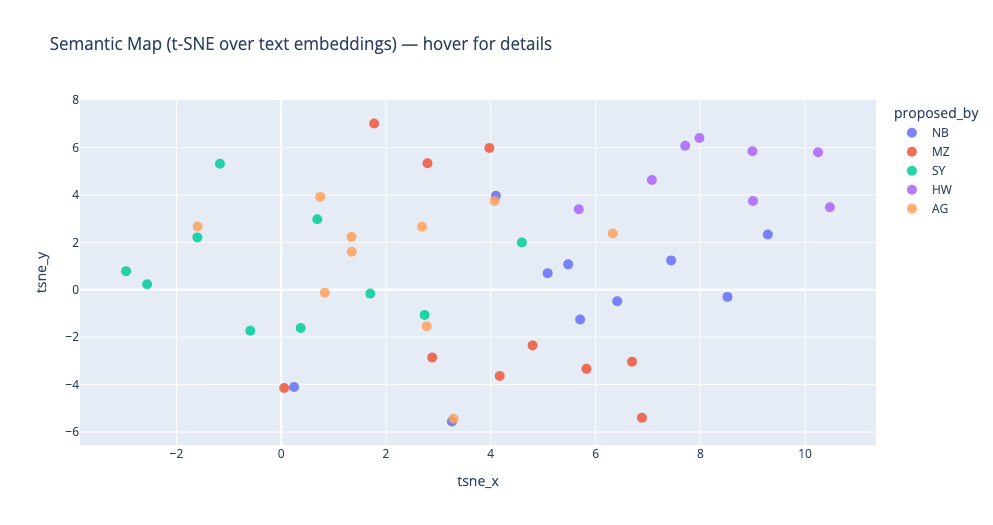
To make sense of all the ideas across the team, we ran them through bubble grids plotting feasibility against impact, t-SNE semantic maps built from text embeddings of the concept descriptions, and cluster analysis to see which ideas were actually saying the same thing in different ways. The t-SNE visualization was one of those moments where the usage of ML unexpectedly paid off. Seeing concept clusters emerge spatially made the selection process feel far more grounded than a spreadsheet ever could.
We then scored our top three concepts against four requirements that came directly from the research: does it sustain engagement over time (not just feel novel on day one), is it realistic to deploy, can it influence behavior without guilt-tripping or punishing the user, and does it create long-term impact rather than a short-term wow moment.
The concept that came out on top was a behavior-shaping artifact. Something that communicates through physical feedback and gentle reinforcement rather than screens or push notifications. The system follows a sense, predict, actuate loop. It senses environmental conditions and user interaction patterns. It predicts whether conditions are declining through a lightweight rule-based inference engine (we deliberately chose interpretability over precision here). And it actuates through physical leaf movements designed to nudge behavior without becoming repetitive or annoying.
This architecture mapped directly onto what my research had surfaced. My interview participant wanted automation and ambient cues, not data. My cooking observation showed that reactive symptom management was the default. The whole point of the sense, predict, actuate loop was to intervene before symptoms show up, using a feedback channel that nobody needs to learn how to read. A plant that droops when something's wrong. That's it.
Building It: Circuit Design and Sensor Calibration
With the concept locked, I moved into hardware. After months of wrestling with ESP32 pin mappings and IR sensor cross-talk on other projects, the embedded systems work on Buddi felt like familiar territory. Different sensors, different actuators, but same fundamental challenge: make the components work together reliably.
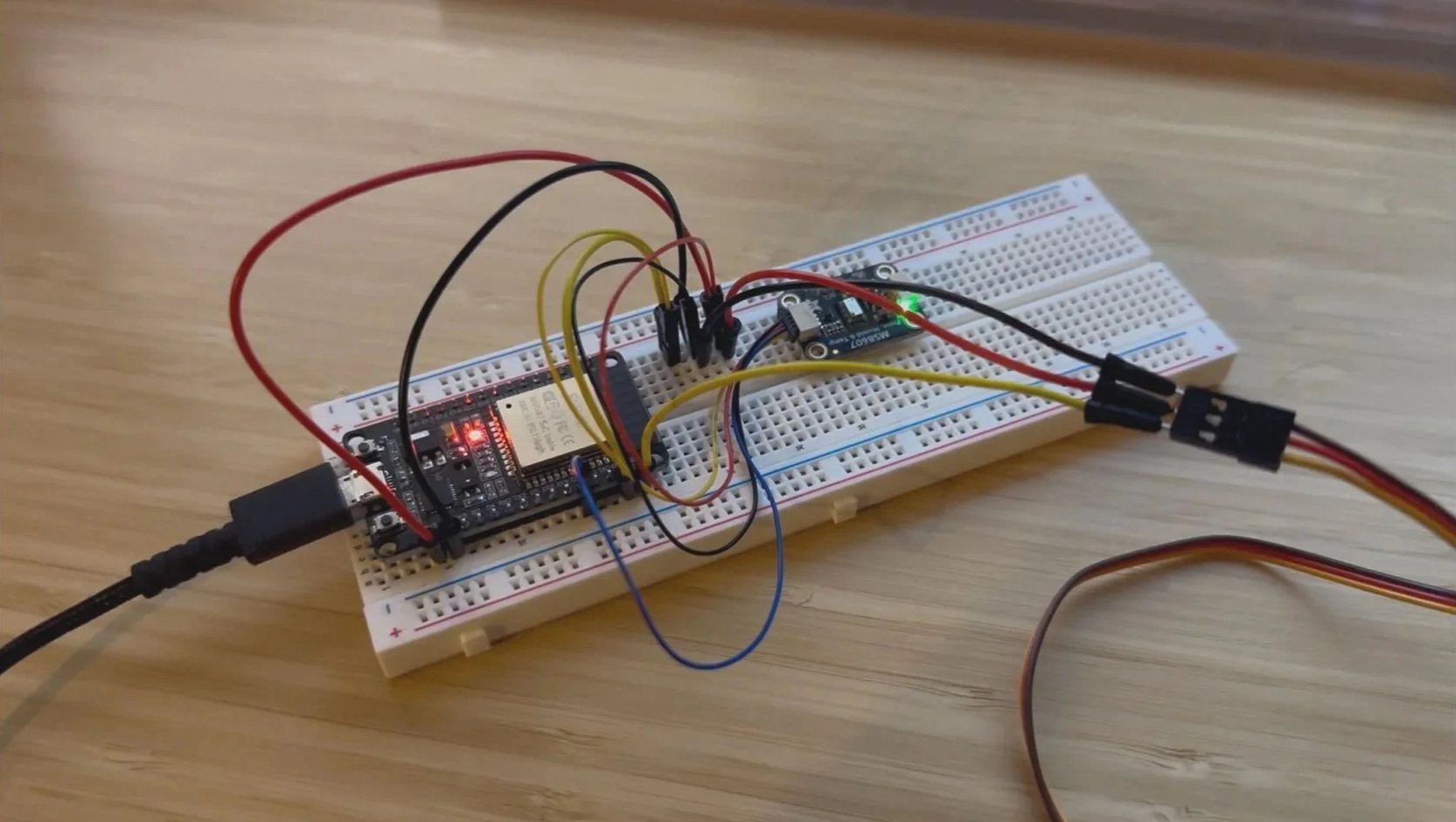
The sensing setup paired a temperature/humidity sensor with an air quality sensor, both feeding into a single microcontroller that also drove the servo outputs for the leaf mechanism. The design priority was keeping the system compact enough to fit inside the plant enclosure while maintaining airflow around the environmental sensors so they wouldn't be skewed by heat from the servos or stagnant air pockets.
On the calibration side, I researched thermal comfort profiles and indoor air quality standards to define what the sensor readings should actually mean for the user. This meant establishing threshold ranges that map to how people experience a room: what temperature and humidity band feels "comfortable" versus "something's off," and at what air quality level should the plant start to respond. From there I defined three state boundaries (healthy, declining, act now) that would drive the leaf posture transitions.
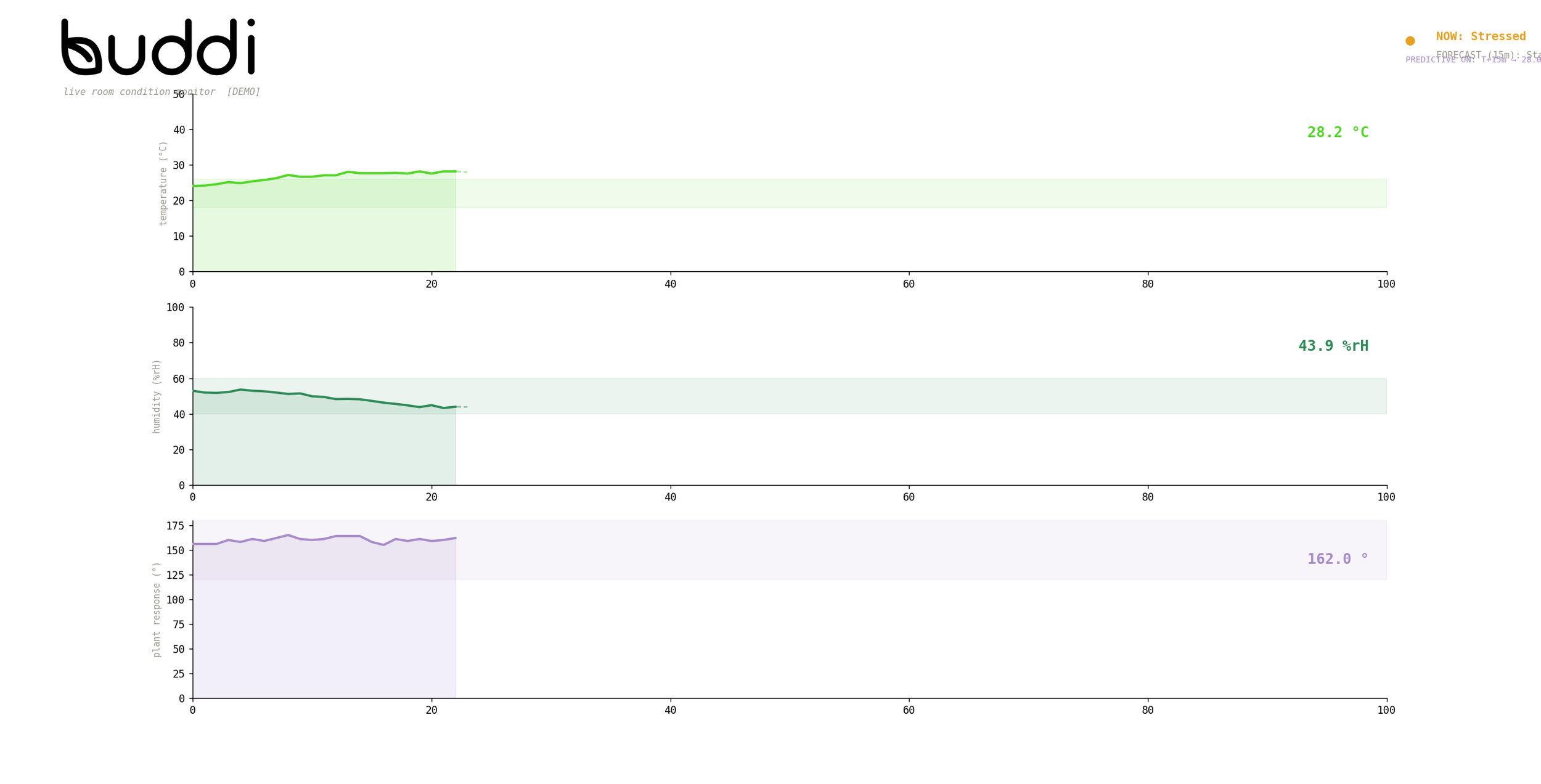
To validate all of this, I built a Python dashboard that monitored the sensor feeds in real time during testing. Yes, the irony of building a data dashboard for a product whose entire thesis is that people don't want data dashboards was not lost on me. But for internal use, it was essential. It let us verify that the sensors were reading accurately in the enclosure environment, that the threshold boundaries triggered when they should, and that the state transitions felt right in practice rather than just on paper.
Getting the sensing architecture right, defining meaningful thresholds, and having the tooling to verify both were equally important. One without the others would have left us with either a working sensor that didn't know what to say, a great interaction model with nothing driving it, or no way to tell if any of it was actually working.
Mechanical Design & Prototyping
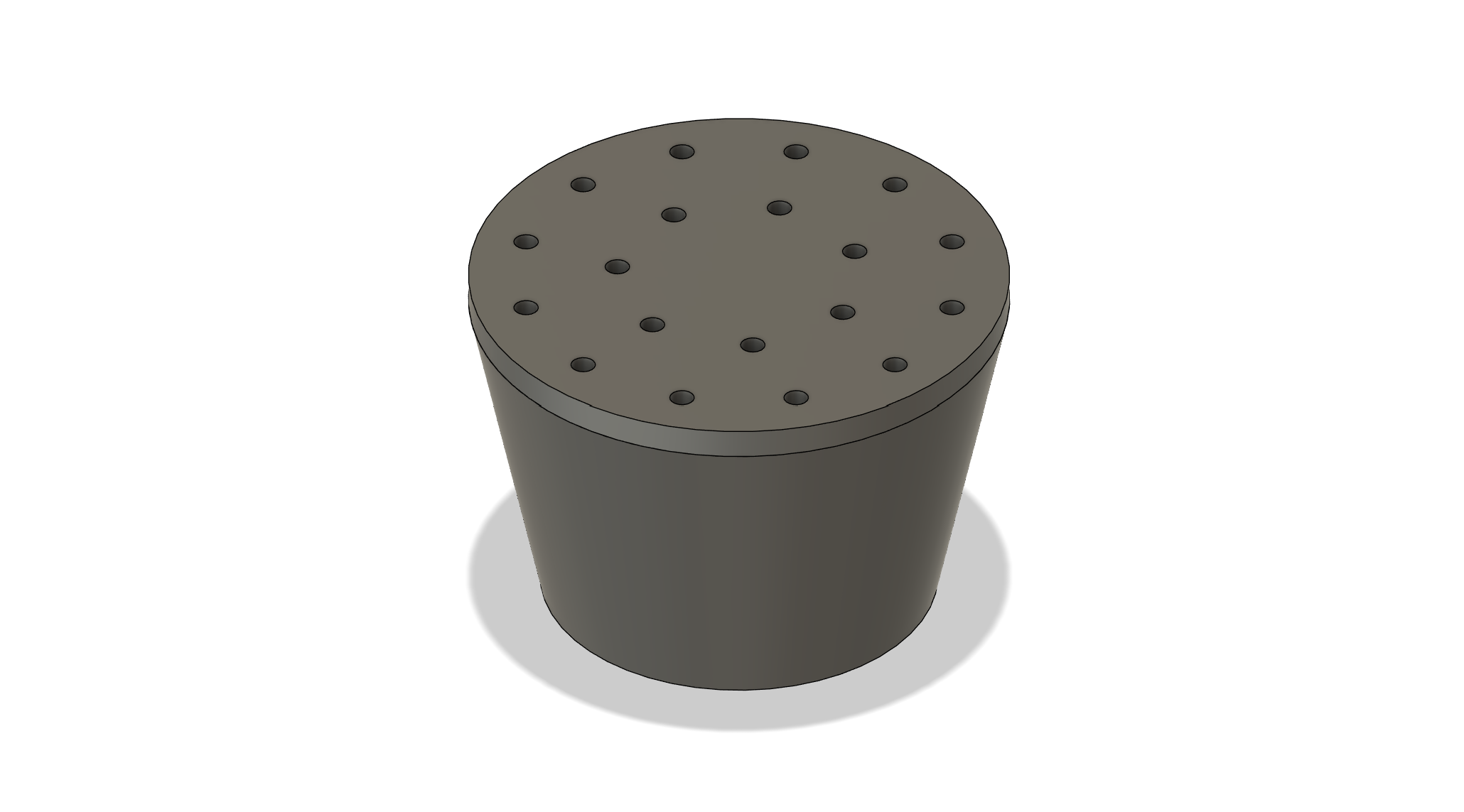
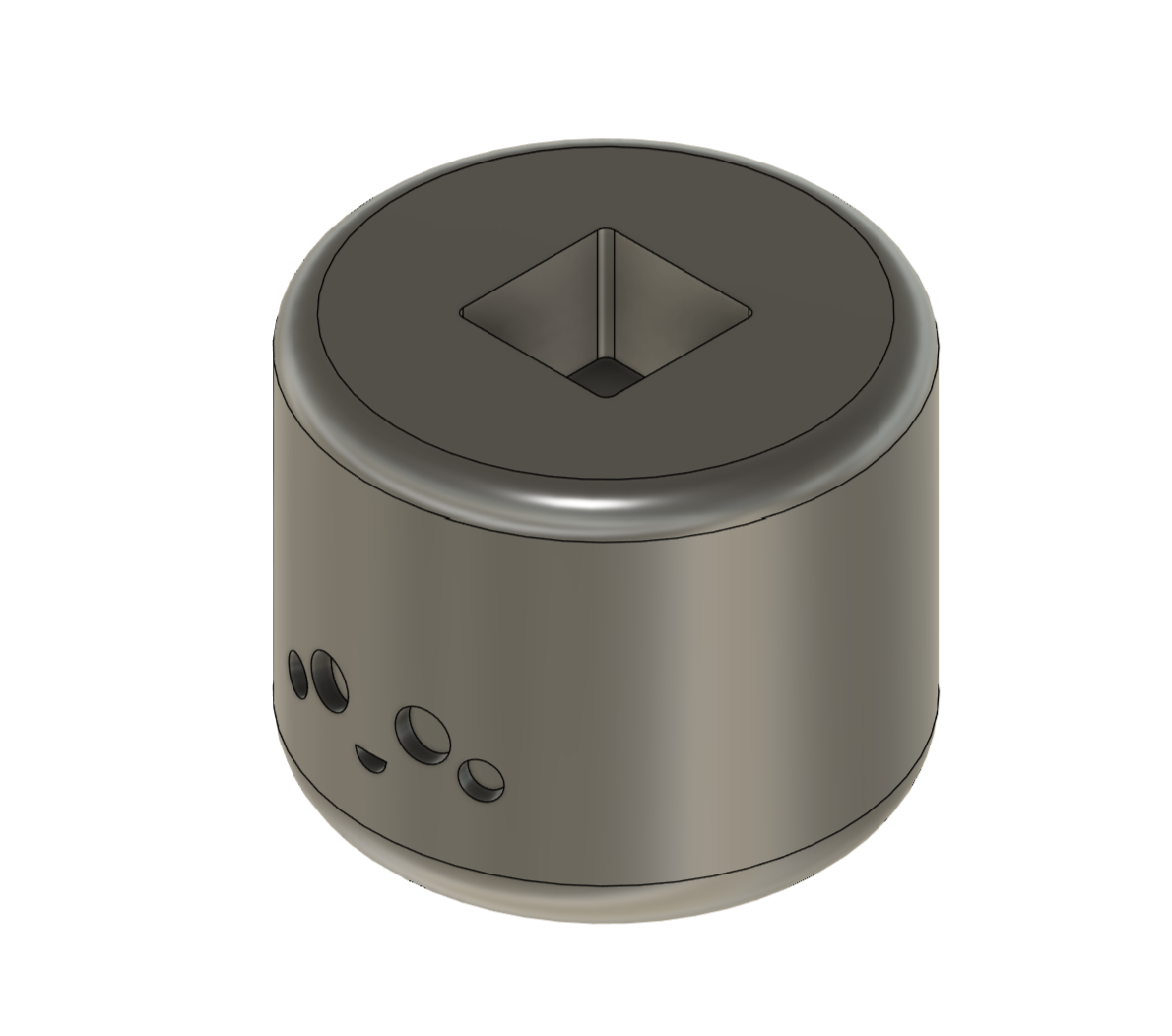
The mechanical work was where every interaction goal ran headfirst into physical constraints. The leaf mechanism needed to produce smooth, organic-looking motion, but it was powered by hobby servos, which are inherently jerky and audible. The enclosure needed to feel like a decorative object you'd put on a coffee table, but inside it had to fit a microcontroller, sensors, servo motors, and a nest of wiring. Anyone who's ever tried to make an electronics project look "finished" knows this is where 80% of the pain lives.
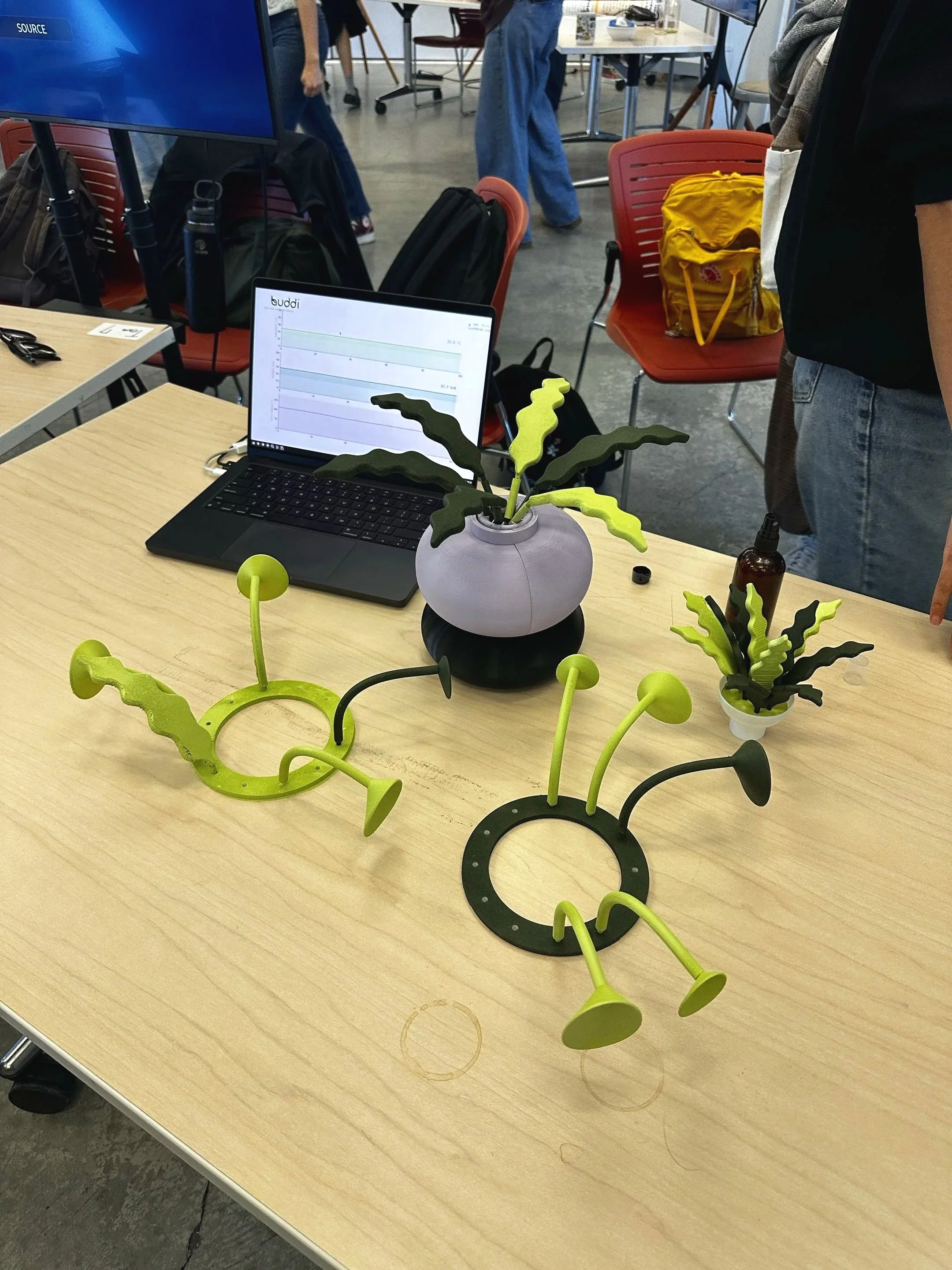
I went through multiple iterations of both the enclosure and the leaf assembly, working in CAD and fabricating physical prototypes to test fit, articulation range, and assembly sequence. The tradeoffs were constant: servo torque versus simplicity (lower-torque designs were easier to ideate but couldn't support the leaf spans we wanted), enclosure volume versus thermal isolation (sensors needed airflow but servos generated heat), and leaf design versus motion fidelity (certain leaf designs did not produce clear visual signals for wilting).
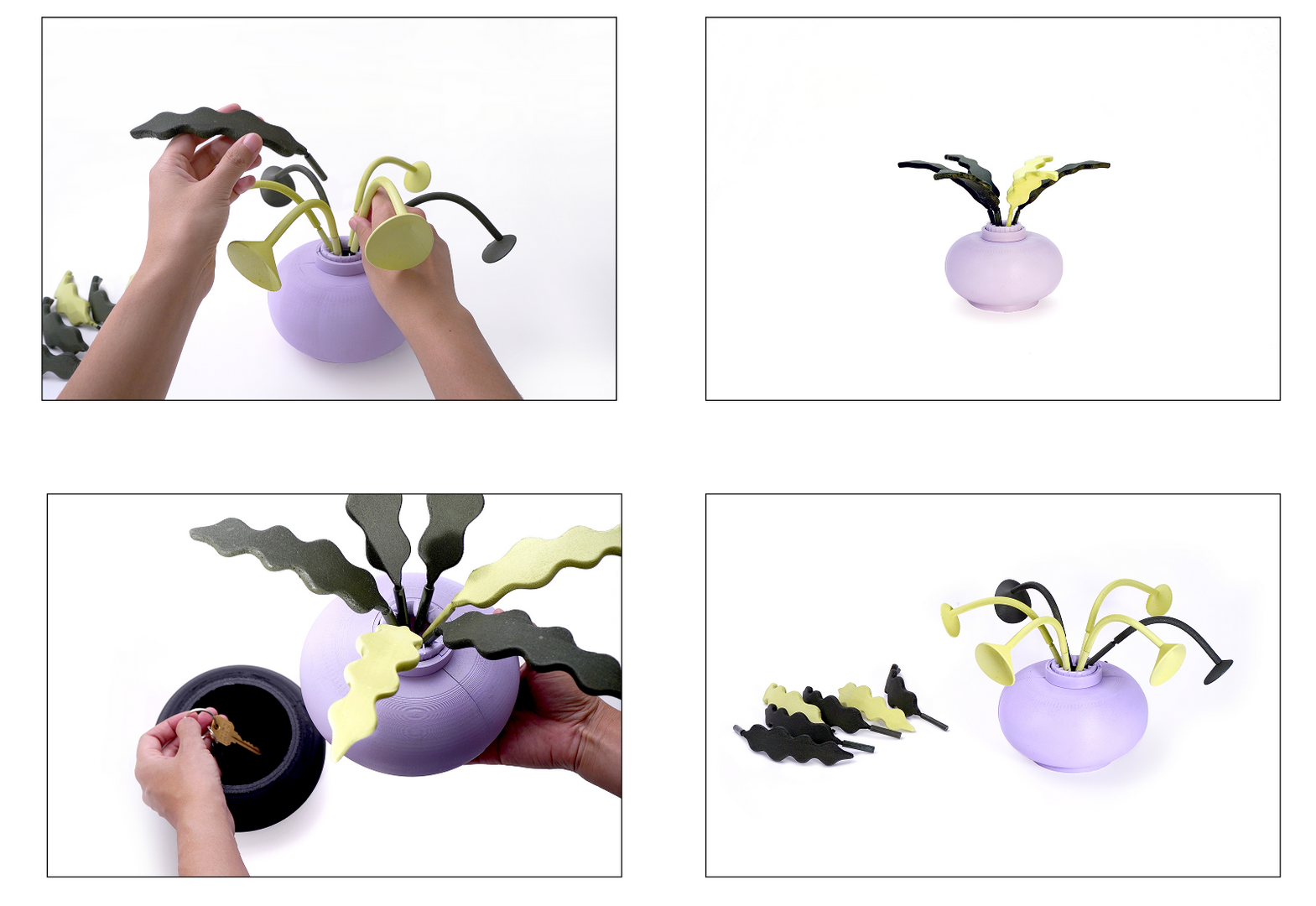
The modular design, removable leaves and accessible internals, was a deliberate choice that served two purposes. From a user perspective, our testing showed people wanted to personalize the plant: requests came in for flowers instead of leaves, different shapes, dynamic color changes. From a development perspective, I needed to swap sensors and servos without destructive disassembly every time I iterated. I learned this lesson the hard way on a previous project. Nothing kills momentum like having to desolder your sensor to fix a wiring mistake.
The user feedback from the showcase confirmed what I'd felt in my hands during prototyping: the two biggest things to fix in a next iteration would be motor noise and visible wires. Both are direct consequences of the fundamental tension in this project. The "living organism" illusion demands silence and seamlessness, while the engineering reality of hobby servos and sensor wiring fights against both.
But by showcase day, Buddi worked. The leaves moved, the sensors read, the thresholds triggered, and nobody who walked up to it thought they were looking at a piece of electronics. We ended up winning the Best Overall Project award at the showcase, which felt like a nice validation that the idea held up beyond just our team's enthusiasm for it. For a one-semester prototype, that felt like the right place to land.
Reflection
This project changed the way I think about what it means to design something.
Research first, engineering second. The most important work I did on Buddi happened before I touched a soldering iron or opened CAD. Sitting across from someone who was genuinely indifferent to her indoor environment, not frustrated, not suffering, just unbothered, taught me that the design challenge wasn't solving a problem people are aware of. It was making an invisible problem legible without adding cognitive load. If I'd jumped straight to hardware, I would have built a better sensor. The research pushed me to build a better communication channel instead. That reordering, understanding the human problem before specifying the technical solution, is the single most transferable skill I'm taking from this project. It's also, I think, what separates the MEng experience from a pure engineering degree: the technical chops matter, but knowing what to build matters more.
Observation changes what you design for. Watching someone cook through a haze of oil smoke without pausing to check their air told me more in 30 minutes than a survey ever could. The gap between what people say they do and what they actually do is exactly where design opportunities live. My participant said they use the exhaust fan, and they do, out of habit, without checking if it works. They said they open the window, and they do, but only after the smoke is already visible. That gap between self-reported behavior and observed behavior is something I want to keep looking for in future projects.
Designing with less. Most of my engineering training has been about maximizing information: more data, more precision, more control axes. From RL reward functions to sensor dashboards, my instinct is always "give the system more signal." Buddi was the first project where the right design decision was consistently about what not to show. A calibrated humidity reading is technically correct and completely useless to someone who doesn't know what 45% relative humidity means or what to do about it. The plant metaphor collapsed that entire interpretation problem. It might be the most elegant thing our team designed, and it came from user research, not engineering.
The prototype always tells you what's wrong. You can plan a smooth, organic, silent plant motion in CAD. Then you print the enclosure, mount the servo, power it on, and it buzzes in your hand. The user feedback about noise and visible wires validated what I already knew from holding the prototype: the gap between the "living organism" illusion and the reality of hobby electronics is the single highest-impact thing to close in a next iteration. Physical products are honest in a way that digital prototypes aren't. They give you feedback whether you ask for it or not. After a semester of sim-to-real gaps on the Go1, I should have expected this. The gap is always there. The question is just whether you've built in enough iteration time to close it.
Thanks for reading! :)